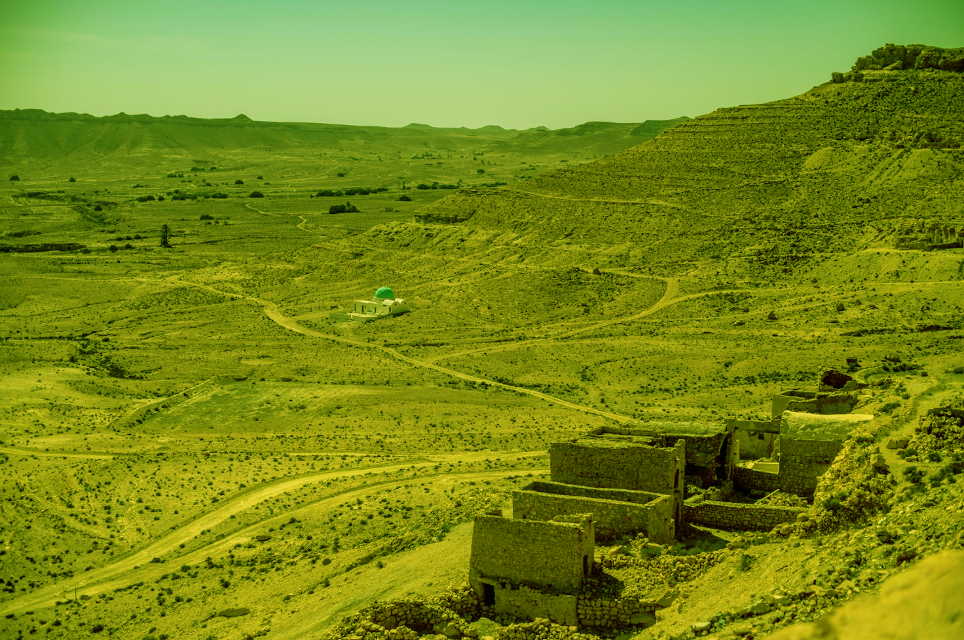
In 2025, the first decentralized EFEST CAMP inaugurated the Agora, a space for collective citizen expression to address the issues facing the Tataouine region. Organized by Echos Electrik in partnership with ASPG, this program offers unprecedented opportunities for dialogue, stimulating the debate of ideas and the exchange of knowledge and viewpoints between local people, researchers, civil society and institutions.
Continuing on from this first experience, the 2026 edition offers an Agora session outside the festival, designed as a scientific and participatory colloquium bringing together national experts and local players, with a view to collectively analyzing the effects of climate change on arid territories and co-constructing appropriate responses, combining traditional knowledge, scientific knowledge and social and cultural innovations.
The final goal of these exchanges will be to draw up a collectively-constructed priority action that can be implemented concretely after the meeting and serve as a lever for initiating other projects with a direct impact on the ground. The ambition is to articulate traditions, sciences and social and cultural innovations to strengthen the territory’s resilience in the face of climate transformations and their repercussions on society and the economy.
Two themes are addressed:
-
Focus 1 – Knowledge, intangible heritage and innovation:
This axis focuses on the intangible heritage of arid territories, made up of empirical knowledge, adaptive practices and forms of social organization developed over the long term, particularly by women and elders. It aims to analyze the ways in which this knowledge is transmitted, valorized and hybridized in a context of rapid climatic and social change.
The axis explores the potential of the dialogue between traditional knowledge, scientific knowledge and technological tools (participatory mapping, digital devices, living labs) as a lever for territorial innovation, with a focus on the involvement of young people, the role of women and the cultural dimension of ecological transition, in order to foster the emergence of inclusive, replicable and socially appropriate devices strengthening the resilience of local communities.
-
Axis 2 – Water and soil: restoring ecological resilience in arid territories:
Water and soil quality, particularly in arid regions, are a structuring factor in all ecological dynamics. As a result, this axis aims to analyze the mechanisms of degradation and adaptation of water-soil systems in arid territories, particularly in Tataouine, where water scarcity, soil degradation and the weakening of collective management methods accentuate territorial vulnerabilities. The project aims to study the conditions for restoring and optimizing traditional agro-hydraulic systems (jessour, tabias, collection works) and agro-ecological practices adapted to arid environments, considering them as functional ecological infrastructures.
The aim is to identify technical, institutional and collective levers for improving water and soil management, boosting the resilience of production systems and supporting the ability of territories to cope with climate variability.
Partner:
IRA, Institut des régions arides de Médenine
Specific objectives:
The specific objectives of the agora organization are:
- Offer a time for exchange between experts, local players and inhabitants to better understand the challenges of climate change and the responses we need to provide.
- Share operational best practices and promote proven traditional know-how in water, soil and agro-pastoral resource management.
- Initiate perennial collective dynamics capable of ensuring the continuity of dialogue and the implementation of a concrete project beyond the meeting.
Moderator:
Mr. Adel Azoueni: PhD student in geology at the Tunis Faculty of Sciences, environment and climate change consultant with the PSSETAT project and author of the book « Sud en mouvement ».
Debates in the presence of the public: 50 targeted, intergenerational and interprofessional participants
Panelists list:
- Mr Samir Khorchani: Doctor in History and Archeology of Ancient Civilizations; Research Teacher at the Institut des Arts et des Métiers in Tataouine, President of the « Association de Sauvegarde du Patrimoine de Ghomrassen
- Mrs Samia Gharbi: scientist, environmental management expert and president of the Association de l’Éducation Environnementale pour Les Futures Générations (AEEFG)
- Mr Ali Abaab: Professor of agronomy, specialist in climate change and natural resources
- Mr Bechir Chibeni: Development expert and socio-economic analyst
- Mrs Rawdha Ammari: Gender and climate change specialist
- Mr Tarek Ben Fraj: Geographer https://www.linkedin.com/in/tarekbenfraj/
- Mr Noureddine Enasser:Professor at INAT and natural resources expert
- Mr Amine Abdallah: https://www.linkedin.com/in/ben-abdallah-amine-32bb45306/
- Mr Radhouen Tiss: History-geography inspector and owner of the Oued Elkhil estate, farmer